
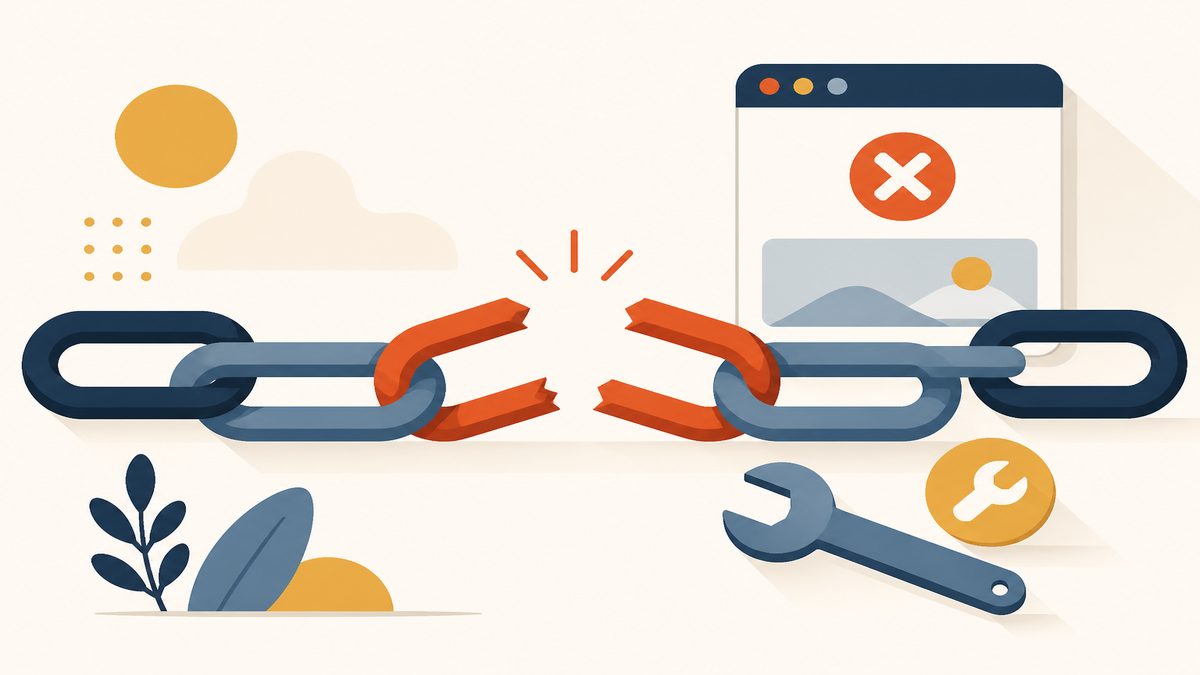
A meaningful share of paid links stop working within a year of publication. Buyers rarely notice, because nobody re-checks a page they paid for eighteen months ago. The link is gone, the ranking effect faded, and the campaign report still counts it.
The five ways a link dies
1. The post is deleted
The most straightforward case. A site prunes old content, changes owner, or decides to clear out sponsored posts. Your URL returns a 404 and the link is gone.
2. The site is redesigned and the URL changes
Common and often unintentional. A CMS migration changes the permalink structure, redirects are set up carelessly or not at all, and your post now lives somewhere else or nowhere.
3. The link is quietly changed to nofollow
The page is still live, the post looks identical, and a rel attribute was added at some point. This is the hardest failure to spot by eye and the easiest to detect automatically.
4. The destination is edited
Your link now points somewhere else, sometimes to a competitor who paid more, sometimes to the publisher's own affiliate offer. The anchor text is unchanged, so a visual check passes.
5. The domain lapses
The publisher stops paying for hosting or lets the domain expire. Sometimes it is parked, sometimes bought by someone rebuilding it as something else entirely. Either way the placement is finished.
Why manual checking does not work
Checking by hand fails for three reasons: it does not scale past a handful of links, it is unreliable for detecting attribute and destination changes, and nobody actually does it on schedule. The result is that link decay is discovered months late, when a ranking drop prompts an audit.
What works is checking every delivered link on a fixed cadence and comparing the result against the terms that were agreed, not against a memory of them. That means the check needs three things recorded at order time: the destination URL, the anchor, and the promised rel attribute.
How BlogReach handles it
When a publisher submits the live post URL, monitoring starts automatically. From then on the page is fetched on a schedule and compared against the order:
- Is the page reachable?
- Is the link still present?
- Does it still point at the agreed target?
- Does the rel attribute still match what was promised?
After consecutive failed checks the placement is marked at risk, the publisher receives a repair request, and a repair window opens. If the window closes without the link being restored, a case opens for review and the publisher's linked wallet can be restricted until it is resolved.
Guest posts carry a twelve-month link-uptime window and link insertions carry six months. Inside that window you can claim the guarantee directly from your order history.
The sequence that actually gets a link restored
- Establish what changed. Removed, redirected, nofollowed, or repointed. The fix differs for each, and a publisher who receives a precise report responds faster than one who receives "my link is gone".
- Contact the publisher with the original terms. Not a complaint: the order record, the agreed target, and what the page shows now.
- Give a defined window. Open-ended requests get deprioritised. BlogReach's default repair window is 72 hours and it is recorded on the placement.
- Escalate to a case if the window closes. At that point the record matters, which is why keeping the conversation and payment on-platform is worth the small friction.
Reducing the failure rate before you buy
Some of this is preventable at purchase:
- Prefer verified owners. An owner can restore a link. A reseller has to ask someone who can.
- Ask about permanence explicitly and get the answer on the order.
- Favour publishers with a delivery record. Link stability is measurable, and sites that have kept links live before tend to keep them live again.
- Be wary of very cheap placements on high-authority domains. That combination is usually a network that will be cleaned up eventually.
Live link health for every order you place is visible in the buying dashboard, alongside the next scheduled check.