
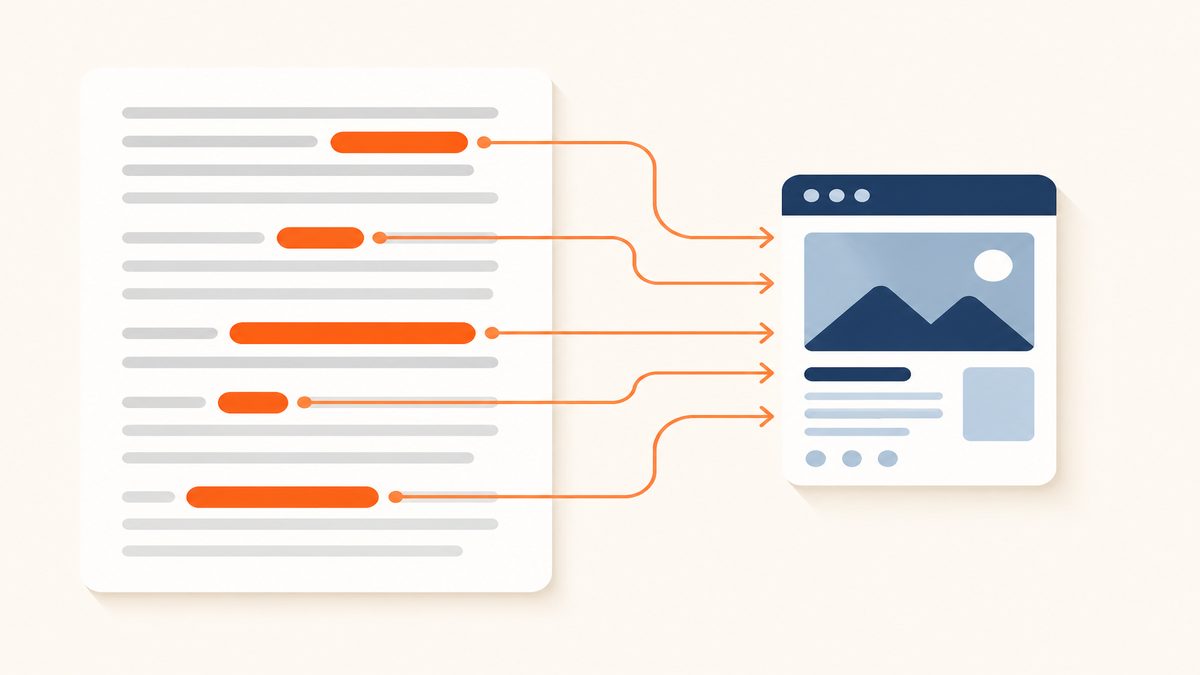
Anchor text is the clickable words in a link. It is one of the oldest ranking signals there is, and one of the easiest to overdo, because the anchor that helps most in isolation is the one that looks worst in aggregate.
The types, and what each one does
- Exact match. The target keyword, verbatim: "project management software". Strongest relevance signal, highest risk when repeated.
- Partial match. Keyword inside a longer phrase: "the best project management software for agencies". Nearly as useful, far more natural.
- Branded. Your company name. Safe at any volume, and the anchor real editorial links use most.
- Naked URL. The address itself. Common in genuine citations.
- Generic. "Click here", "this guide", "read more". Passes little topical signal but appears constantly in real writing.
- Image. The alt text of a linked image serves as the anchor.
What a natural distribution looks like
There is no official ratio, and anyone quoting one to two decimal places is guessing. But the shape of a profile built by real citations is consistent, and it is not what most people build deliberately.
Real profiles are dominated by branded and naked-URL anchors, because that is how people cite things. Exact match is the smallest slice, not the largest. If exact-match anchors are your most common type, your profile does not look earned.
A reasonable working target for a profile built through outreach:
- Branded and naked URL together: roughly half.
- Partial match and topical phrases: most of the rest.
- Generic: a meaningful slice, because real writing uses it.
- Exact match: a small minority, used where it genuinely fits the sentence.
Match the anchor to the page, not the campaign
The most common error is using the same anchor for every link because it is the keyword on the target page. Search engines see the pattern across the web, not one link at a time.
Vary by context instead. The anchor should be the words the sentence needed anyway. If you have to bend a sentence around the anchor, the anchor is wrong, and any editor worth publishing with will change it.
Anchors for deep pages versus the homepage
Homepage links attract branded anchors naturally, which is convenient because that is also what is safest. Deep pages, product pages and resource pages are where exact match is tempting and where restraint matters most.
For a deep page, a descriptive partial-match anchor is almost always the right answer: it tells search engines what the page covers, and it tells readers what they will get if they click.
Practical rules
- Write the sentence first, choose the anchor second. If the link cannot be inserted without rewriting the paragraph, it does not belong there.
- Never repeat the same exact-match anchor across placements. Vary the phrasing every time.
- Send the anchor with the order. Do not leave it to the publisher to guess, and do not let it be changed silently.
- Check what was published. Anchors get edited during publication more often than buyers realise.
- Keep a record across campaigns. The pattern is only visible when you look at every link you have bought, not the one in front of you.
Where this connects to your orders
On BlogReach, the target URL and anchor text are set at checkout and stored on the order, so what you asked for is a matter of record rather than recollection. Delivered links are then checked against that target, and a changed destination or altered anchor surfaces as a monitoring alert.
If you are planning a campaign across several sites, the campaign builder will assemble a matching set from live offers so you can plan the anchor spread before you buy rather than after.